Carlantonio Longi, the Versatile Painter
Edited by Paolo Zelati, Editorial Director
June 15, 2026
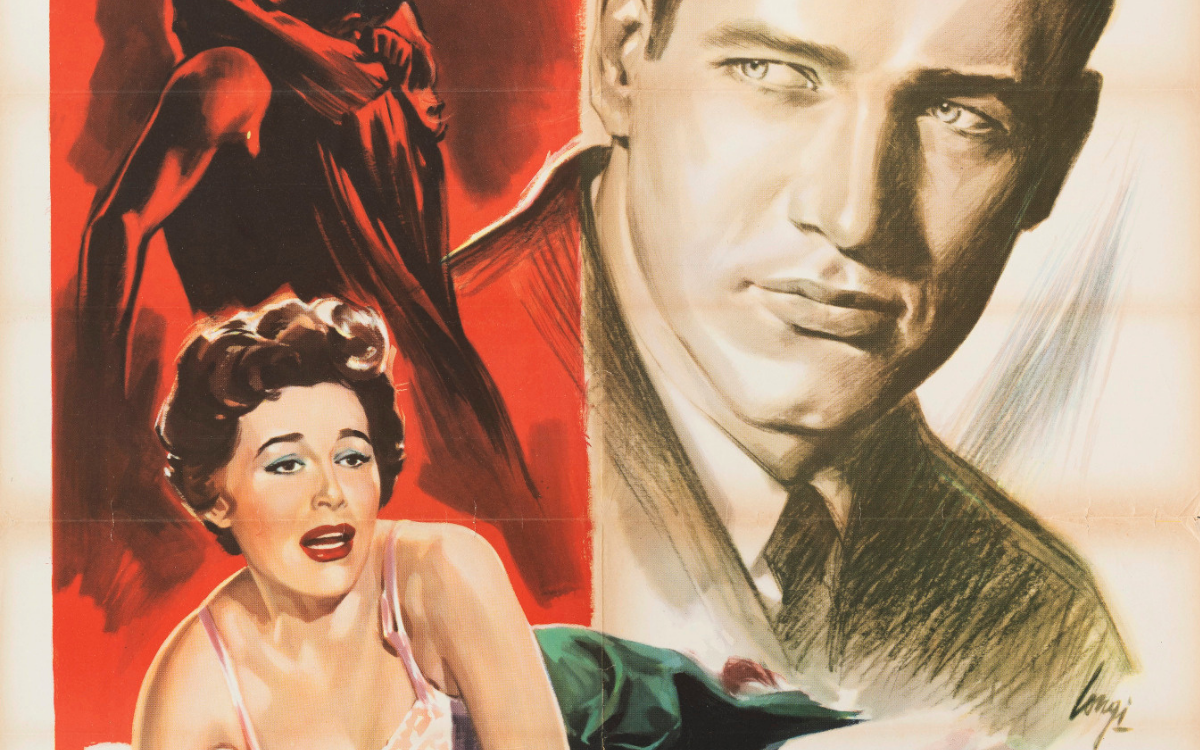
In the corner of hundreds of posters, beneath Harold Lloyd's outstretched arm as he dangles from a clock, beside Paul Newman's face, at the feet of Bergman's hooded Death, the same signature always appears: "Longi." A single hand behind a vast body of work, able to move from American slapstick to European art-house cinema without ever losing its recognizability. Behind that signature is Carlantonio Longi, one of the painters who gave the big screen a painted face.
From Frascati to the Academy
Carlantonio Longi was born in Livorno on 8 September 1921, but his childhood was wholly Tuscan in spirit. His father, Eugenio, was transferred to Frascati as director of TE.TI, the company that ran the telephone network at the time, and the family settled a few steps from the Politeama cinema: in a sense, the cinema grew up right next to him. He studied at the Istituto d'Arte in Florence as a pupil of Gianni Vagnetti, then continued in Rome, at the Liceo Artistico and the Accademia di Belle Arti, under Carlo Siviero. These names are worth remembering: not a generic apprenticeship, but two exacting masters of the Italian figurative tradition, who left him an uncommon command of portraiture. His preferred technique was gouache (tempera guazzata) on paper, and with it he learned to capture a star's features in a few strokes.
He began very young as a portraitist, even before becoming a man of cinema; it was partly his meeting with the actor Tino Buazzelli that drew him toward theatre and show business, and from there to the poster. When he arrived in cinema, Longi joined a generation of poster artists born between 1918 and 1928, Angelo Cesselon, Averardo Ciriello, Silvano Campeggi, Sandro Symeoni, Rodolfo Gasparri, each in search of a personal signature. His own sat halfway: less theatrical than an Enrico De Seta, who gave his sheets an almost musical dynamism, yet more versatile than many, ready to change skin from one film to the next.
A Tuscan Coincidence
There is one detail that captures Longi's bond with his era better than many words. When, for the Italian release of Henri-Georges Clouzot's The Wages of Fear (Vite vendute, 1953), Longi portrayed Yves Montand, he was setting down on paper the face of an almost exact contemporary and near-compatriot: Montand had been born Ivo Livi in Monsummano, in Tuscany, in that same 1921. Two Tuscan boys of the same year, one became a star of French and American cinema, the other the painter who fixed his face on the poster bound for Italian theatres. It is one of those stories that often hide behind a poster and that are worth remembering.
The First Manner: Storytelling in Colour
Longi's film career spanned almost three decades, from the early 1940s to the late 1960s, virtually the whole "golden age" of Italian cinema. The first season, the postwar years, was the richest and most narrative. Longi built his posters like illustrated pages, crowded with scenes and colour: you can see it in Camerini's Woman Trouble, in Visconti's Senso, in The White Sheik (Lo sceicco bianco), Fellini's debut, or in the Italian edition of The Wizard of Oz, where Judy Garland's astonished face shares the frame with the Wicked Witch of the West and the Wizard in a composition straight out of a storybook.
The most unrestrained example is perhaps Neapolitan Carousel (1954), Ettore Giannini's film-ballad honoured at Cannes: a kaleidoscope in which every corner tells you something. It was exactly what a poster was asked to do in those days, to make the film recognizable at a glance and, at the same time, to promise its emotional "temperature."
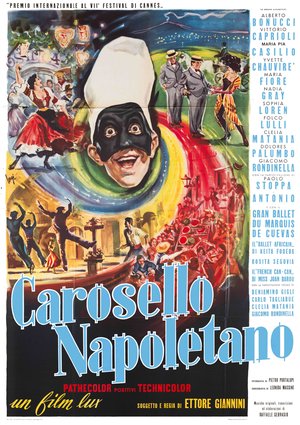
Neapolitan Carousel (Ettore Giannini, 1954)
The poster for Neapolitan Carousel (Carosello Napoletano) is Longi's most narrative: a centrifugal composition in which dozens of scenes chase each other around a central mask. The bright palette and the horror vacui, with every corner filled, still belong to the traditional poster-narrative. Strength lies in richness rather than in concision.
A Hand for Every Genre
Versatility was his hallmark: no genre was foreign to him. For slapstick there is the famous Harold Lloyd clinging to the hands of a clock, in A rotta di collo (the anthology Harold Lloyd's World of Comedy). Hollywood, too, reached for his portraits of sheer virtuosity, like that of a young Paul Newman for The Young Philadelphians (Warner Bros, 1959). His brush, after all, gave form to the faces of half a century: Totò and Sophia Loren, Mastroianni and Alberto Sordi, Vittorio De Sica and Judy Garland and Gary Cooper, Humphrey Bogart, Peter Sellers too. This, in the end, was the craft, to make the star of the moment instantly recognizable, and Longi did it with the assurance of a true portraitist.
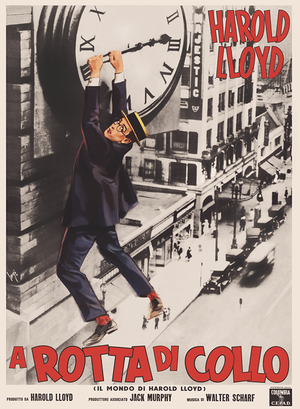
Harold Lloyd's World of Comedy (Harold Lloyd, 1962)
The poster for the film Harold Lloyd's World of Comedy. The idea is hybrid: a hand-painted, full-colour figure superimposed over a black-and-white photographic urban view. The contrast between painting and photography makes the character stand out and accentuates the vertigo of the vertical fall. A poster that plays entirely on the tension between two different languages.
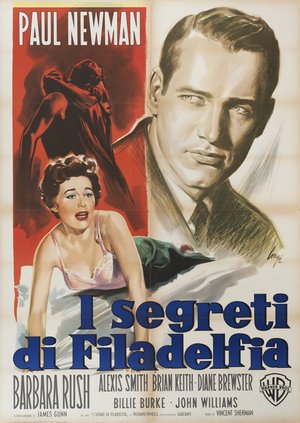
The Young Philadelphians (Vincent Sherman, 1959)
The poster The Young Philadelphians is built on a large frontal portrait, modelled with the softness of a life drawing, set against a more graphic red panel. This is where Longi's virtuoso gift for portraiture shows: the face as the absolute centre, against the chromatic synthesis of the ground. Realism and graphic design coexist on the same sheet.
Then there is the art-house side. Globe Films International, the company that brought the great foreign titles to Italy, chose two of Longi's posters that have remained memorable: Ingmar Bergman's The Seventh Seal and the "locandina" (Italian small format) for Kon Ichikawa's The Burmese Harp , a prize-winner at Venice. Two utterly distant films, two opposite solutions, the same intelligence of the image. In the same way he would later serve cinema at the far ends of the spectrum, all the way to Pasolini's The Hawks and the Sparrows (Uccellacci e uccellini).
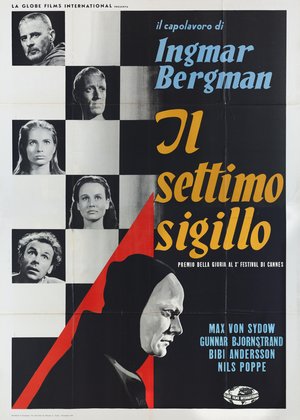
The Seventh Seal (Ingmar Bergman, 1957)
In this poster for the film The Seventh Seal by Longi turns to graphic synthesis: a chessboard of black and white faces, a hooded figure painted almost in grisaille and a single red lightning bolt that cuts through the composition. The rigorous geometry and the economy of colour mark his most modern style. The isolated red concentrates all the tension.
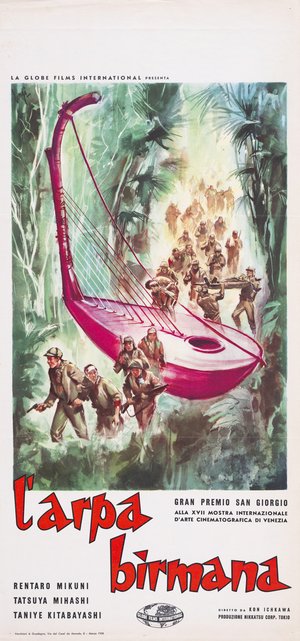
The Burmese Harp (Kon Ichikawa,1956)
The locandina, The Burmese Harp in its tall vertical format, everything is organised around a single great crimson symbol that dominates the space. The transparent, watercolour-like washes build an atmosphere rather than a scene. Longi reduces the image to one essential poetic sign and lets the ground breathe.
The Second Manner: Synthesis
It is precisely the Bergman poster that marks the shift to his second manner. From the early 1960s Longi changed register: he abandoned narrative crowding for a more essential, dramatic graphic style. In Antonioni's L'avventura the story condenses into an embrace on a red ground, Monica Vitti's face seen at an angle and her blonde hair standing out: few figures, few colours. The same synthetic instinct returns in Dreyer's Day of Wrath (Dies irae) or in Hiroshima mon amour, where everything is reduced to a single intense detail, two hands clawing at a back, passion and pain in one gesture. Longi understood, before many others, that the modern poster need not tell everything: the right mark is enough.
A Return to Painting
Toward the end of the 1960s he gradually left poster work for advertising graphics, and in the 1970s he moved with his family to Florence to devote himself solely to painting. It was a return to his origins: his easel work, boats, seascapes, landscapes, looks to the Tuscan macchia and places him squarely within the Livorno school. The vivid palette, however, remained that of the illustrator. He died at his home in Sinalunga on 5 September 1980, a few days short of his fifty-ninth birthday.
What remains is an archive of more than three hundred original sketches and boards, kept by his family and brought back to light in exhibitions with a fitting title: "Il Cinema Dipinto" (painted cinema). It is the truest definition of Longi's work, a cinema, quite literally, painted by hand, in those years when the first glimpse of a film, before the film itself, was a picture pinned to a wall.
The works reproduced on this page come from the original prints of the period, recovered, photographed and digitally restored by Movie.it.